Photo de Maxime Estavoyer

Maxime Estavoyer

Postdoctoral Researcher in Applied Mathematics and Biological Modeling
Français English

In November 2024, I defended a PhD thesis in applied mathematics, which I began in February 2022, under the supervision of Thomas Lepoutre, as part of the ANR project Plume, led by Marie Manceau.

Since April 2025, I have been a postdoctoral researcher under the supervision of Matthias Merkel in Marseille, where I work on the mathematical modeling of embryogenesis.

My research focuses on the mathematical modelling of biological phenomena, with particular emphasis on the emergence of spatially periodic stationary patterns and the analysis of travelling waves in reaction–diffusion PDE systems and nonlinear kinetic models. These systems may exhibit certain features, such as nonlocal interactions, biased diffusion, or the inclusion of a structural variable.
Campus de Luminy, 163 Av. de Luminy, 13009 Marseille

Recent Research

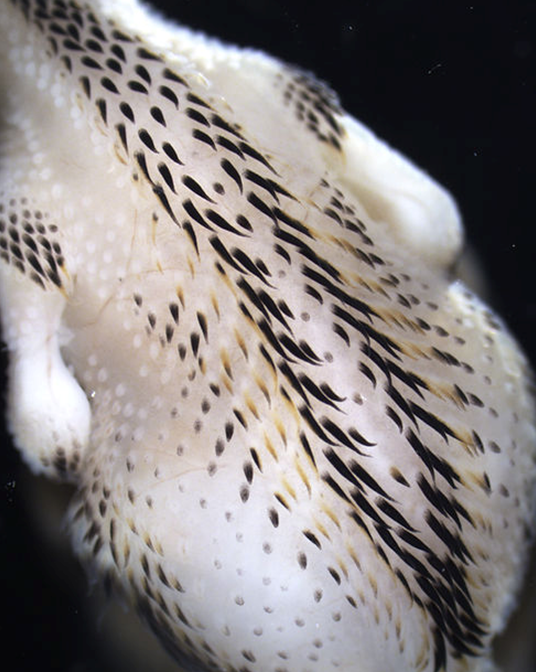
Schéma de plumes d'oiseaux

Image credit: Aulehla Lab

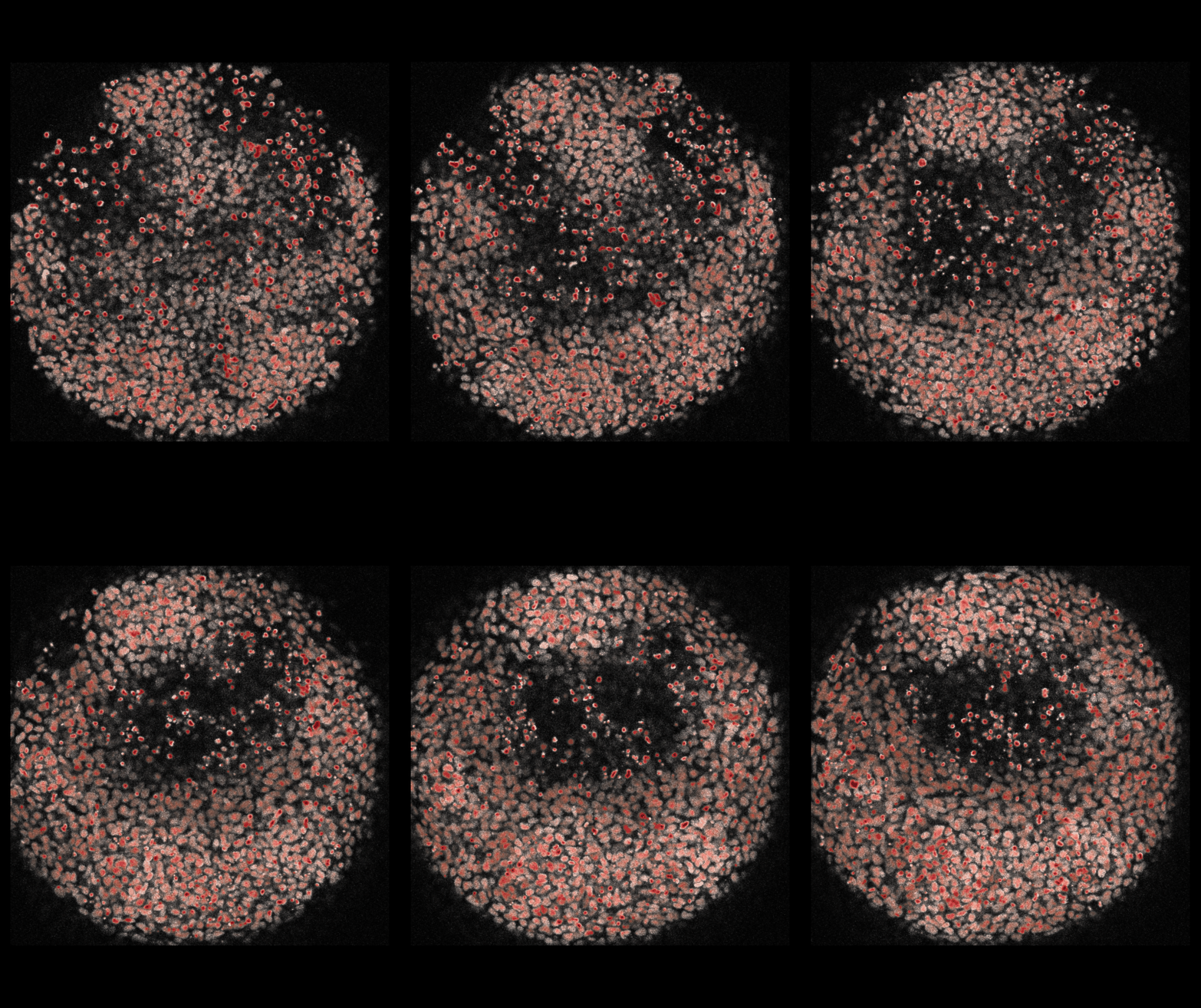
Study of morphogenetic pattern formation

In collaboration with Matthias Merkel.

Abstract : Pattern formation is a fundamental process in development, resulting from the combined action of cell motility, gene regulation, division dynamics, and apoptosis. However, quantifying the contribution of each of these factors to the emergence of spatial structures remains a challenge. We have developed a method based on a Bessel–Fourier mode decomposition to assess these contributions. Applying this approach to aggregates of Brachyury-expressing stem cells, as well as to agent-based models simulating various pattern formation scenarios, reveals a complex interplay between these processes. By linking individual trajectories to collective structures, our method provides a powerful tool for deciphering the underlying dynamics of pattern formation during morphogenesis.

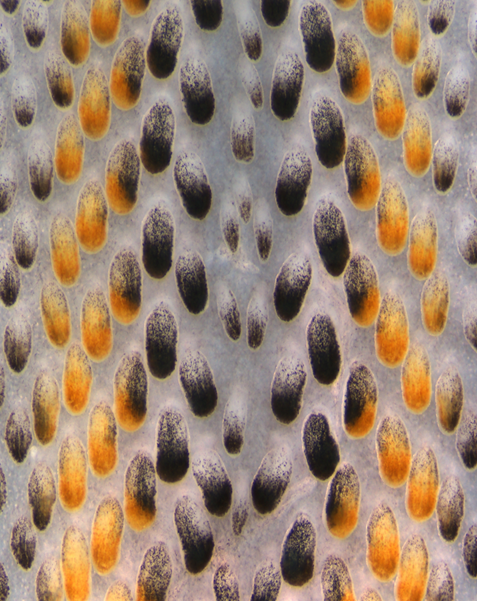
Temporal establishment of a pre-pattern controlling stripe formation in birds

In collaboration with the team of Marie Manceau, in particular her PhD student Coline Hermine.

Abstract : The yellow and black stripes of the dorsal plumage of juvenile gallinaceous birds result from how pigment cells respond to positional signals emitted several days before the onset of pigmentation. By combining interspecies comparisons, ex vivo experiments, mathematical modeling, and in vivo functional assays, we show that the pigmentation gene Agouti is expressed in two successive waves. The first wave establishes a “pre-pattern” in the dermis by locally reducing the number of melanocyte progenitors at the sites of future yellow stripes. A second, later wave acts within feather follicles by slowing melanocyte differentiation and modulating the type of melanin produced. Together, these actions link early embryonic cues to the late activity of specialized cells and are sufficient to generate the alternation of yellow and black stripes. Simple variations in the timing, level, or duration of Agouti expression thus provide a mechanism by which stripe width, color, and structure can evolve among gallinaceous species.

Schéma de plumes d'oiseaux

Image credit: Manceau Lab

Schéma de plumes d'oiseaux

Image credit: Manceau Lab

Modeling the arrangement of feather follicles

Article [9] : In collaboration with Thomas Lepoutre and the team of Marie Manceau.

Abstract : During avian morphogenesis, feather follicles emerge row by row following a medio-lateral wave, through a two-step process: dermal densification that renders the tissue competent, followed by the formation of cellular aggregates leading to future follicles. Using a reaction–diffusion–chemotaxis model combined with linear and weakly nonlinear analysis, we derive explicit formulas for the speeds of competence and follicle emergence. Simulations show that when the emergence speed exceeds the competence speed, follicles synchronize with the latter, while competence remains independent of emergence. This approach provides a precise estimate of both the temporal pace and the spatial organization of follicles in an initially naïve tissue.

Modeling the invasion of the predatory bacterium Myxococcus xanthus

In collaboration with Thomas Lepoutre, Vincent Calvez and the team of Tâm Mignot.

Abstract : In this project, we investigate the invasion dynamics of the predatory bacterium Myxococcus xanthus, whose populations display a heterogeneous organization: isolated bacteria at the leading edge and faster-moving clusters in their wake, reflecting the coexistence of two motility modes, adventurous and social. To describe this phenomenon, we employ several complementary modeling approaches, ranging from reaction–diffusion systems (discrete or size-structured) to a transport–reaction model incorporating movement persistence. These frameworks reveal the existence of critical thresholds in the motility ratio between isolated cells and clusters, separating distinct propagation regimes, as well as possible transitions between “normal” and “anomalous” invasion speeds. Finally, simulations reproduce key experimental trends, including synergistic effects between the two motility modes and an increase in invasion speed when the disparity between isolated cells and clusters is sufficiently pronounced.

Schéma de plumes d'oiseaux

Image credit: Mignot Lab


Publications/Preprints

Filtrer :

[9] Maxime Estavoyer, Thomas Lepoutre et Marie Manceau : Mathematical modeling of dermal competence and cellular aggregation effects on feather follicle emergence speed, Journal of Theoretical Biology, 2025. [Link]

+

[8] Maxime Estavoyer : A reaction telegraph model reveals synergy between motility strategies in Myxococcus xanthus predation, preprint, 2025. [Link]

+

[7] M. Estavoyer, M. Banerjee, N. Torres, J. Blohm, L. Pujo-Menjouet : Spatial pattern analysis of an Aβ-monomer model with inflammation processes for Alzheimer’s disease, Mathematical Modelling of Natural Phenomena, 2025. [Link]

+

[6] M. Estavoyer, M. Dufeu, G. Ranson, S. Lefort, T. Voeltzel, V. Maguer-Satta, O. Gandrillon, T. Lepoutre : Modeling relaxation experiments with a mechanistic model of gene expression, BMC Bioinformatics, 2024. [Link]

+

[5] Maxime Estavoyer et Thomas Lepoutre : Travelling waves for a fast reaction limit of a discrete coagulation-fragmentation model with diffusion and proliferation, Journal of Mathematical Biology, 2024. [Link]

+

[3] J. Restier-Verlet et al. : Accelerated Aging Effects Observed In Vitro after an Exposure to Gamma-Rays Delivered at Very Low and Continuous Dose-Rate Equivalent to 1–5 Weeks in International Space Station, Cells 2024. [Link]

+

[2] B. Jumentier, C-C. Barrot, M. Estavoyer, J. Tost, B. Heude, O. François, J. Lepeule : High-Dimensional Mediation Analysis: A New Method Applied to Maternal Smoking, Placental DNA Methylation, and Birth Outcomes, Environmental health perspectives, 2023. [Link]

+

[1] Maxime Estavoyer et Olivier François : Theoretical Analysis of Principal Components in an Umbrella Model of Intraspecific Evolution, Theoretical Population Biology, 2022. [Link]

+

Proceedings

[4] V. Calvez, A. El Abdouni, M. Estavoyer, I. Madrid, J. Olivier, M. Tournus : Regime switching on the propagation speed of travelling waves of some size-structured Myxobacteria population models, ESAIM: Proceedings and Surveys, 2024. [Link]

+

Thesis (in French)

Maxime Estavoyer, Propagation et émergence de motifs en biologie, sous la direction de Thomas Lepoutre, 2024. [Link]